

Changes
- AI Chat Assistant: Chat with an AI model through your own provider, just in your editor.
- LaTeX Error Assistant: Get AI-suggested fixes for LaTeX compilation errors.
- Mendeley integration: Import references from Mendeley similar to Zotero.
- Open in Overleaf API: Added an API for opening content in Overleaf.
- Template Gallery: Added server-side pagination, search, and sorting, so large galleries no longer need to load every template in the browser.
- Translations: Updated translation patches for 6.3.0, including new interface text across supported languages.
- Upstream Overleaf 6.3.0: Includes tabbed file editing, separate header logos for light and dark themes, and dependency and base image updates.
- Added
OVERLEAF_HEADER_IMAGE_URL_LIGHTandOVERLEAF_HEADER_IMAGE_URL_DARKto support separate header logo images for light and dark themes. - Files can now be opened in different tabs in the editor.
- External URL fetching and the Open in Overleaf API now support HTTP(S) proxies through
OVERLEAF_LINKED_URL_OUTBOUND_PROXY. See Outbound Proxy for configuration.
Feature 01: AI Assistant is available now
The AI Assistant lives in the side rail of the editor and talks to the model provider you configure. Ask it the kind of thing you’d ask a colleague: tighten this paragraph, what does this macro do, why won’t my table line up. It doesn’t answer blind. It can read and search the files in your project, check the LaTeX diagnostics, compile the project and even look at the rendered PDF pages, so its answers come from your actual document. When it wants to change something, it shows you a diff first. Nothing is written until you approve it, so the paper stays yours.Feature 02: Open in Overleaf API
If you run a course page, a template library or a documentation site, you can now give readers a button that drops them straight into a working project. This feature is enabled by default. Visityour.overleaf.com/devs for the full reference and live examples.
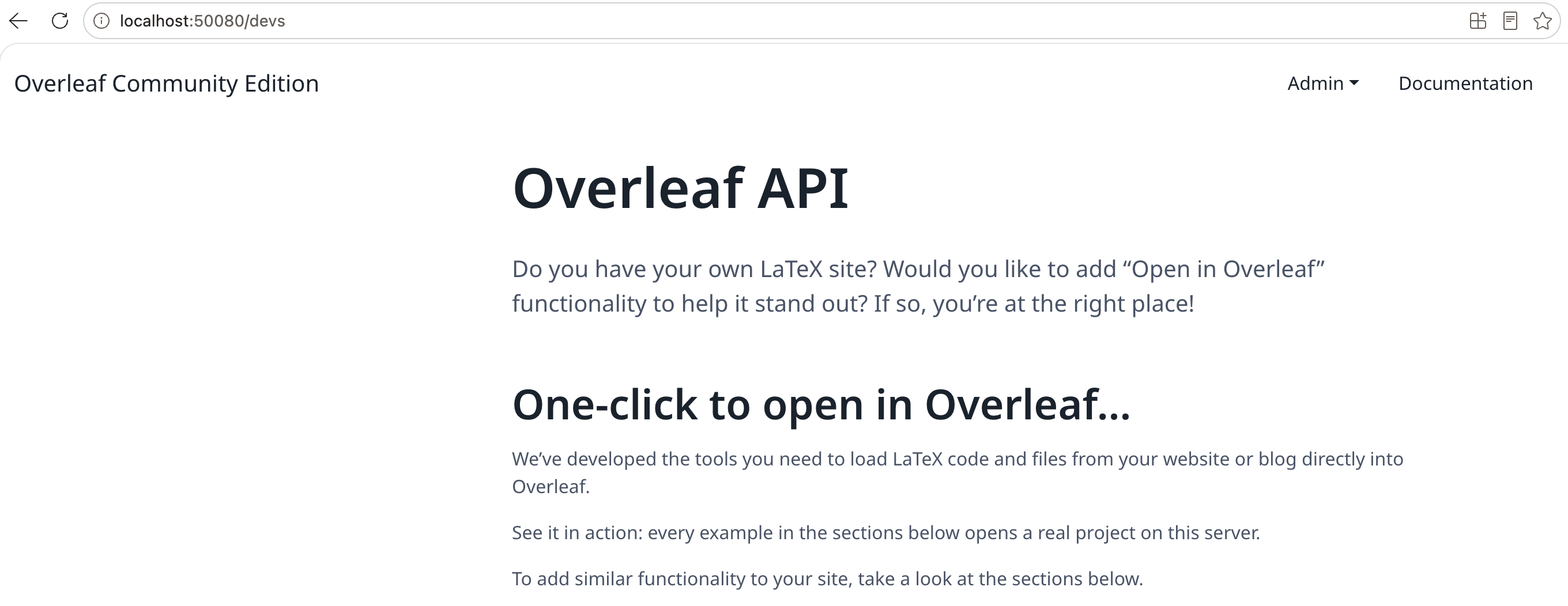
snip or encoded_snip), and a bare fragment gets wrapped in a minimal document for you. You can point to one or more remote files with snip_uri (up to 50 at a time), or hand over a whole project as a ZIP with zip_uri. Optional parameters set the compiler (engine), the main document (main_document) and the project name (name). The content opens as a new project in your instance, ready to edit and compile. If the visitor isn’t signed in yet, they log in first and still land in their new project.
Feature 03: Mendeley integration
In 6.2 we added Zotero, and Mendeley users have been asking for the same ever since. Link your Mendeley account, pick a library or group, and your references come in as a.bib file you can refresh whenever your library changes. Just like on overleaf.com, in a shared project only the person who imported the file can refresh it.
For admins: add mendeley to ENABLED_LINKED_FILE_TYPES and set MENDELEY_CLIENT_ID and MENDELEY_CLIENT_SECRET from your Mendeley developer app.
See Mendeley Integration for the full setup instructions.
Feature 04: Template Pagination
The gallery used to load every template into the browser and sort them there. Fine for fifty templates, painful for five thousand. Now paging, searching and sorting all happen in MongoDB, and the browser only receives the page you’re looking at. It works without any preparation. If your gallery has thousands of templates, these indexes will keep it fast. The script is safe to run more than once; replacemongo and sharelatex with your container and database names:
collation on the two *_ci indexes as written — the gallery queries with the same collation and MongoDB only uses a matching index.
Others
For external file imports, configureOVERLEAF_LINKED_URL_OUTBOUND_PROXY to use an HTTP(S) proxy, including a locally hosted proxy. This setting applies to both linked URL files and remote ZIP or TeX resources imported through the Open in Overleaf API. See External URL — Outbound Proxy for setup and network access restrictions.
- Added
OVERLEAF_HEADER_IMAGE_URL_LIGHTandOVERLEAF_HEADER_IMAGE_URL_DARKto support separate header logo images for light and dark themes. - Files can now be opened in different tabs in the editor.
Docker Image
You can find docker image here: https://github.com/ayaka-notes/ayakaleaf-pro/pkgs/container/overleaf-proOfficial Release Notes
Official Release Notes
Release date: 2026-08-28TexLive 2026 is available for Server Pro instances running Sandboxed Compiles. Check the documentation for instructions to upgrade and the Release Notes for the key changes introduced in this version.New Features
- Added
OVERLEAF_HEADER_IMAGE_URL_LIGHTandOVERLEAF_HEADER_IMAGE_URL_DARKto support separate header logo images for light and dark themes. - Files can now be opened in different tabs in the editor.
- Security updates to the base image and installed packages.